Day 1 CPT: The One Rule That Decides Whether It Costs You Your OPT
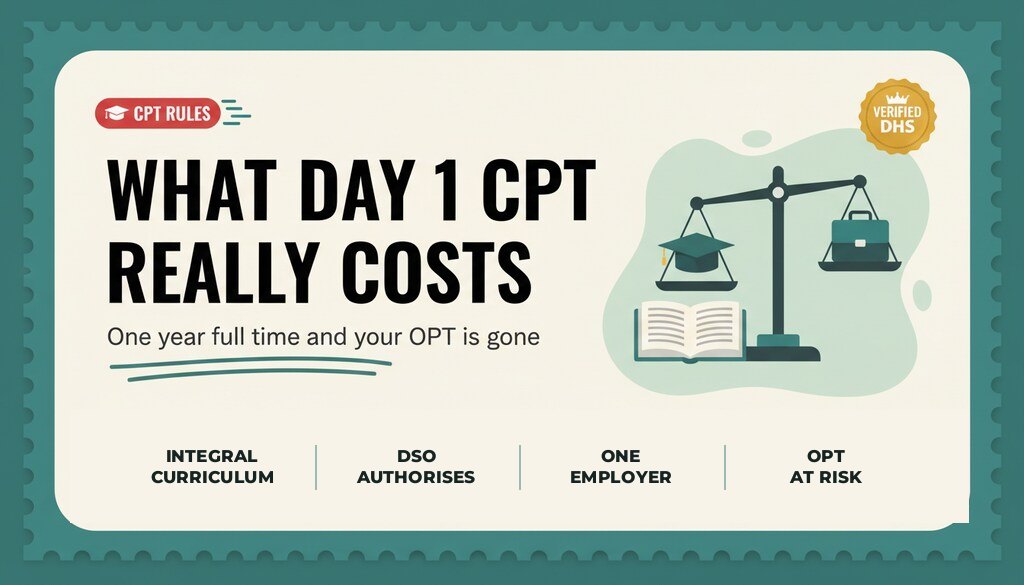
One year of full-time CPT eliminates your OPT eligibility, including the STEM extension. That is DHS's own wording, and it is almost never in the brochure. Here is what CPT actually requires.
In this guide (7 sections)
Search for "day 1 CPT" and you will find universities promising you can start working the week you enrol. The arrangement is marketed hard to Indian students who need to keep an income while staying in status.
Almost none of that marketing mentions the rule that decides whether the whole plan works — and it is a single sentence in the federal guidance.
What CPT actually is
DHS defines curricular practical training narrowly. It is alternative work/study, an internship, cooperative education, or any other type of required internship or practicum offered by sponsoring employers through cooperative agreements with the school.
To be CPT at all, the training must be:
- an integral part of an established curriculum;
- directly related to your major area of study; and
- completed before the program end date on your Form I-20.
Read the first condition again. CPT is not permission to work that your school hands out because you need a job. It is training that the curriculum itself requires. If the course would be complete without it, it is not integral — and the authorisation rests on the school asserting that it is.
How it is supposed to work
- You secure the training opportunity first. DHS is explicit: the student must secure the opportunity before CPT can be authorised. No speculative authorisation.
- You make an official request to your DSO, who must confirm you are participating in an established curriculum where the training is integral, and determine that it relates directly to your major.
- The DSO authorises it in SEVIS and the authorisation prints on your Form I-20.
- Only then can you start. CPT must be authorised before you begin work, and you cannot start before the CPT start date shown on the I-20.
The authorisation is for one specific employer and one specific period. You may hold more than one CPT authorisation at a time, but each employer and each segment needs its own. A signed cooperative agreement or a letter from the employer is required.
The trade nobody puts in the brochure
Here is the arithmetic that matters.
| CPT | OPT | |
|---|---|---|
| Part of the curriculum? | Must be integral to it | Must not be an integral part of it |
| Who authorises | Your DSO, in SEVIS | USCIS, via Form I-765 and an EAD |
| Employer | One specific employer per authorisation | Any employer, if related to your major |
| Timing | Before the program end date | Before or after the program end date |
| Need a job first? | Yes — secure it before authorisation | No |
| Duration | 12 months full-time destroys OPT | 12 months per education level |
OPT gives you 12 months at each education level — so a bachelor's and then a master's can each carry their own 12 months — and for eligible STEM fields a further 24-month extension on top. Spending a year on full-time CPT to earn sooner means trading all of that away.
For most people in a technical field that is a bad trade, because the STEM OPT extension is the bridge that makes an H-1B attempt realistic. Our OPT and STEM OPT guide explains the extension, and our cap-gap guide explains why that runway matters.
The signal most students miss
DHS's SEVIS Help Hub directs designated school officials to two broadcast messages issued in August 2026: guidance for DSOs regarding curricular practical training, and a reminder of liability for DSOs regarding CPT authorisation.
A regulator does not issue a liability reminder to school officials about a practice it considers uncontroversial. That is worth knowing before you choose a programme whose main selling point is immediate work authorisation.
Questions to ask before enrolling anywhere that advertises day 1 CPT
- "Is this training integral to an established curriculum?" Ask to see where it appears in the programme requirements — not the admissions page.
- "Will my CPT be full-time or part-time, and for how many months in total?" This is the question that decides whether you keep OPT. Get the answer in writing.
- "Is the school SEVP-certified, and accredited by whom?" Check it yourself on ICE's Certified School List rather than taking the website's word.
- "What is the CIP code on my I-20?" It decides STEM OPT eligibility — assuming you still have OPT.
- "How many class hours are actually required, and where?" A programme structured so you are mostly working and rarely studying is the pattern that attracts scrutiny.
- "What happens to my status if the CPT authorisation is questioned?"
Where CPT is entirely legitimate
None of this makes CPT suspect in itself. A required internship in an engineering master's, a practicum in a clinical programme, a co-op term in an established cooperative education degree — these are exactly what the regulation describes, and they are a normal part of a US degree.
The distinction is not CPT versus no CPT. It is whether the training is genuinely required by the curriculum, and whether you are spending so much of it full-time that you lose the thing that actually gets you to an H-1B.
What we have not published
We have not named any school, and we are not going to. We have also not set out part-time hour thresholds or the mechanics of counting months toward the twelve, because those turn on the specific authorisation and your DSO's records. Ask your DSO for your cumulative full-time CPT total in writing before you accept another segment — that one number decides whether OPT is still available to you.
Questions
Does CPT affect my OPT eligibility?
Is day 1 CPT legal?
What exactly qualifies as CPT?
Can I start working as soon as I find a CPT job?
Can I have CPT with more than one employer?
Who authorises CPT — my school or USCIS?
How much OPT would I be giving up?
What should I ask a university that advertises day 1 CPT?
Sources: DHS Study in the States — F-1 Curricular Practical Training (CPT), SEVIS Help Hub · ICE — Practical Training (CPT and OPT) · ICE SEVP — Certified School List · DHS Study in the States — Eligible CIP Codes for the STEM OPT Extension