EB-1: The Green Card Route With No Employer and No Labor Certification
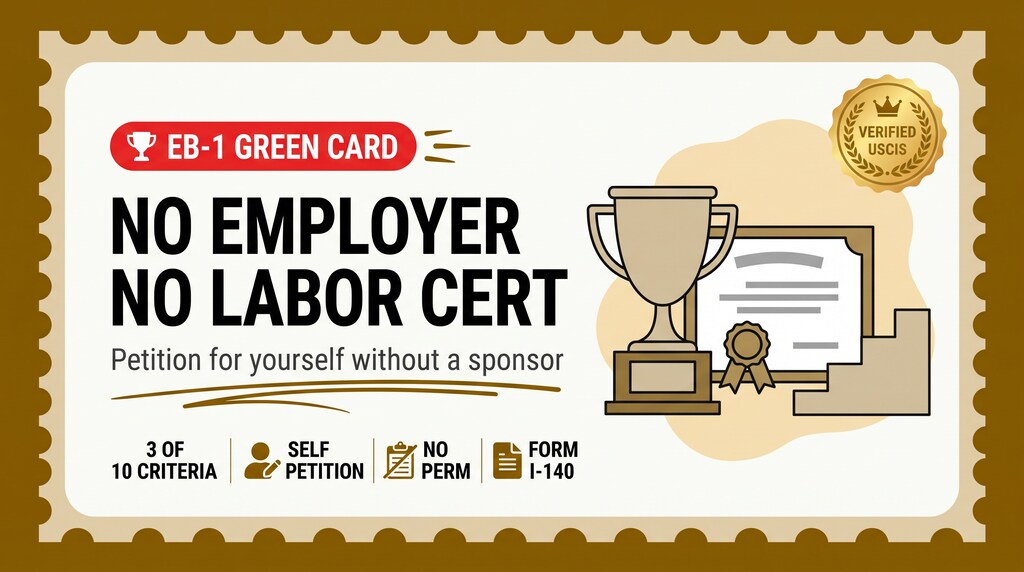
EB-1A lets you petition for yourself: no employer, no job offer, no labor certification. It is also the hardest standard in the system — here is how to tell honestly whether you are near it.
In this guide (7 sections)
Almost every green card conversation starts with the same assumption: you need an employer to sponsor you, and you need PERM. For two routes in the first preference, neither is true.
EB-1A lets you petition for yourself. No employer, no job offer, no labor certification. It is also the hardest standard in the employment-based system, and most people who try it do not meet it. This article is about telling those two things apart honestly.
What EB-1 actually contains
EB-1 is the employment-based first preference, and USCIS splits it into three sub-categories. None of them requires a labor certification:
| Sub-category | Who it is for | Employer needed? |
|---|---|---|
| Extraordinary ability | Sustained national or international acclaim in the sciences, arts, education, business or athletics | No — you may self-petition |
| Outstanding professor or researcher | International recognition for outstanding achievement in an academic field | Yes — needs a job offer |
| Multinational manager or executive | Transferring in a managerial or executive capacity within the same business group | Yes — the employer petitions |
The third row is the one most readers of this site are already positioned for without realising it — it is the green card counterpart of the L-1A transfer.
EB-1A: the self-petition route
USCIS states it plainly: "No offer of employment or labor certification is required." You file Form I-140 for yourself.
To qualify you must demonstrate extraordinary ability through sustained national or international acclaim, and either:
- provide evidence of a one-time achievement — USCIS gives Pulitzer, Oscar and Olympic Medal as the examples — or
- meet at least 3 of the 10 criteria below.
You must also show you will continue to work in your area of expertise.
The 10 criteria, as USCIS lists them
- Receipt of lesser nationally or internationally recognised prizes or awards for excellence
- Membership in associations in the field which demand outstanding achievement of their members
- Published material about you in professional or major trade publications or other major media
- Evidence that you have been asked to judge the work of others, individually or on a panel
- Your original scientific, scholarly, artistic, athletic or business-related contributions of major significance
- Authorship of scholarly articles in professional or major trade publications or other major media
- Your work displayed at artistic exhibitions or showcases
- Performance of a leading or critical role in distinguished organisations
- Evidence that you command a high salary or other significantly high remuneration relative to others in the field
- Commercial successes in the performing arts
USCIS also allows comparable evidence where a criterion does not readily apply to your field.
Which criteria an engineer can realistically build
Several of the ten are plainly aimed at artists and athletes. For someone in a technical or business field, the ones that are actually reachable are:
- Judging the work of others — peer review for journals or conferences, judging hackathons or industry awards, serving on technical programme committees. This is the single most buildable criterion, and it takes time rather than luck.
- Authorship of scholarly articles — papers, but also substantive articles in recognised trade publications.
- Leading or critical role — evidenced by what the organisation says about your role, not by your job title.
- High salary relative to others in the field — this one is measurable, and our salary data by role and city plus the prevailing wage comparison are exactly the kind of benchmark used to show it.
- Published material about you — about you and your work, not quotes from you in a listicle.
Outstanding professor or researcher
A lower bar than EB-1A, but it needs an employer. USCIS requires that you:
- demonstrate international recognition for outstanding achievement in the field;
- have at least 3 years of experience in teaching or research in that area;
- be entering the US to pursue tenure, tenure-track teaching or a comparable research position at a university, institution of higher education, or a private employer; and
- meet at least 2 of 6 criteria, with an offer of employment.
If the employer is private, it must show documented accomplishments and that it employs at least 3 full-time researchers.
The six criteria are major prizes or awards; membership in associations requiring outstanding achievement; published material written by others about your work; participation as a judge of others' work; original scientific or scholarly research contributions; and authorship of scholarly books or articles in journals with international circulation.
Multinational manager or executive
This is the quietest route and the one most often missed. USCIS requires:
- employment outside the US for at least 1 year in the 3 years preceding the petition — or preceding your most recent lawful nonimmigrant admission, if you are already working for the US petitioner;
- a US petitioner that has been doing business for at least 1 year, with a qualifying relationship to the entity you worked for abroad; and
- that the petitioner intends to employ you in a managerial or executive capacity.
Why skipping PERM is worth so much
PERM is the longest and least controllable stage of the EB-2 and EB-3 route. It is the employer's filing, it certifies a job rather than a person, and changing employer, title or location can force it to restart.
EB-1 removes it. For EB-1A it also removes the employer, which means your petition is not hostage to one company's willingness to sponsor — and it does not restart when you move.
What EB-1 does not remove is the visa queue. EB-1 is still subject to per-country limits, so applicants chargeable to India still wait for a priority date. It is a faster route through the paperwork, not around the backlog.
An honest assessment before you spend money on this
- Most strong engineers do not qualify for EB-1A. Being very good at your job is not the standard; sustained national or international acclaim is.
- It is buildable over years, not months. Judging, publishing and documented leading roles accumulate.
- If you are a manager at a multinational, check the third route first. It is often far closer than EB-1A.
- If you are a researcher with a job offer, check the second.
- EB-2 with a national interest waiver also allows self-petition at a lower bar — we cover its three prongs in the PERM and I-140 guide.
This is a category where the quality of the petition genuinely changes the outcome, and where an experienced immigration attorney earns their fee. Use this article to work out which of the three routes fits you, then take advice on that one.
What we have not published
No approval rates, no processing times, no filing fees, and no checklist of "what counts" for each criterion. Approval depends on the totality of the evidence rather than a scoring rubric, and anyone publishing a guaranteed formula is selling something. The USCIS Policy Manual chapters are linked below.
Questions
Can I apply for a green card without an employer?
How many EB-1A criteria do I need to meet?
Is meeting three criteria enough to be approved?
Which EB-1A criteria can a software engineer realistically meet?
What is the difference between EB-1A and EB-1B?
Does EB-1 skip PERM?
Does EB-1 avoid the India green card backlog?
I am on an L-1A. Does that help my green card?
Sources: USCIS — Employment-Based Immigration: First Preference EB-1 · USCIS — Permanent Workers · USCIS Policy Manual — Volume 6, Part F (Employment-Based Classifications) · USCIS — Form I-140, Immigrant Petition for Alien Worker