Laid Off on an H-1B: What the 60-Day Clock Really Gives You
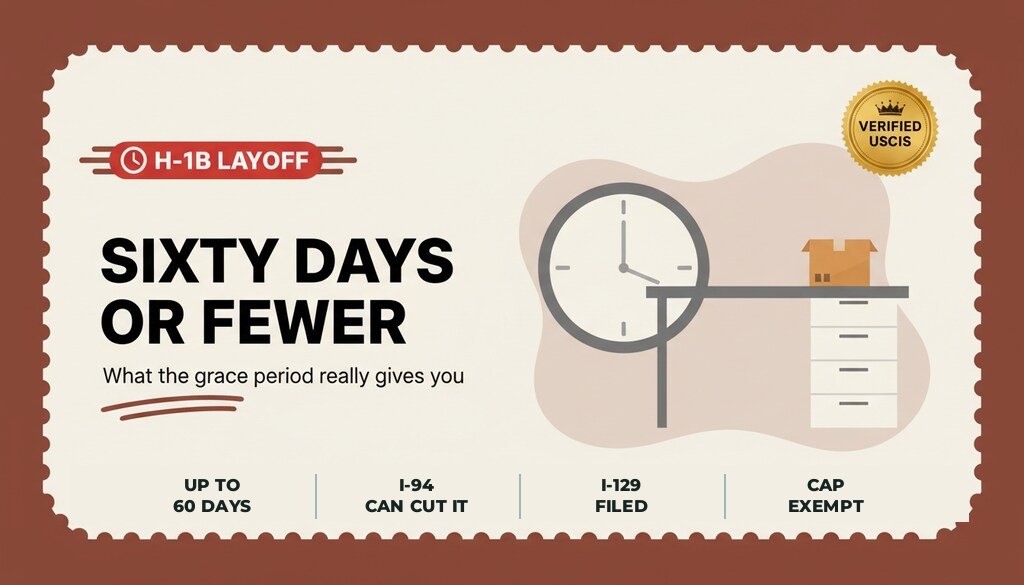
Up to 60 consecutive days, or until your I-94 expires — whichever is shorter. An offer letter does not stop the clock; only a properly filed I-129 does. Here is the whole picture.
In this guide (7 sections)
The email arrives on a Tuesday. By Friday you are out, and a clock you did not know existed is already running.
Being laid off on an H-1B is not the same as being laid off. Your right to be in the country was attached to the job, and it ends with it. This is what the rules actually say, and what you can do inside the window.
The clock, precisely
USCIS states that if your employment ends you may have up to 60 consecutive days, or until the end of your authorized validity period, whichever is shorter, to find new employment, change status, or depart.
Every word matters:
- Up to 60 — a ceiling, not an entitlement.
- Consecutive — calendar days. Not working days. It does not pause.
- Whichever is shorter — this is the part people miss. If your I-94 expires in 22 days, you have 22 days, not 60.
What "find new employment" actually requires
Not an offer. Not a verbal yes. A properly filed, non-frivolous Form I-129.
USCIS states you may begin working for a new H-1B employer as soon as they properly file that petition, or as of the requested start date on it, whichever is later — and that the petition must be filed before your period of authorized stay expires.
Portability also has a condition that can disqualify you entirely: USCIS states you must not have been employed without authorization at any time since your last admission to the US. Our portability guide covers how that works in full.
Your realistic options inside the window
| Option | What it needs | Honest assessment |
|---|---|---|
| New H-1B employer | A properly filed I-129 before your stay expires | Best outcome. Not cap-subject if you are moving between cap-subject employers. |
| Change to H-4 | A spouse in valid H-1B status | Keeps you in status. Work requires a separate H-4 EAD, which has its own conditions. |
| Change to F-1 | Admission to an SEVP-certified school, an I-20 | Real, but study is now on a fixed admission period and costs money. |
| Change to B-2 | A filing before your stay expires | Buys time to wind up affairs. You cannot work on it. |
| Cap-exempt employer | A university, affiliated nonprofit, or nonprofit/government research organisation | No lottery, and they can file at any time of year. Genuinely underused. |
| Depart | — | Leaving in status is far better than overstaying. It preserves your record. |
The cap-exempt option is the one most people forget
USCIS lists institutions of higher education, related or affiliated nonprofit entities, nonprofit research organisations and government research organisations as not subject to the numerical cap. They can petition at any time, with no lottery.
If your profile fits a university or research role, that is a door open year-round while the cap-subject world waits for March. Note the reverse: moving later from a cap-exempt employer to a cap-subject one does make the new petition cap-subject.
Things that are commonly got wrong
- "My last day is my termination date." Not necessarily. Severance, accrued leave and the date your employer reports to USCIS can differ. Ask HR in writing what date they are treating as the end of employment, because your clock runs from the facts, not from your badge being deactivated.
- "I can keep working while I look." No. Working past the end of authorised employment is unauthorised employment, and it breaks portability for every future petition.
- "The 60 days reset if I find something and it falls through." It does not.
- "I should just leave immediately." Not necessarily — the grace period exists to be used. But use it deliberately, not by drifting.
If you have an approved I-140
This changes the picture materially and is worth specialist advice immediately.
An approved I-140 is what unlocks H-1B extensions beyond the sixth year under 8 CFR 214.2(h)(13)(iii)(E), where you are the beneficiary of an approved EB-1, EB-2 or EB-3 petition and would be eligible but for the per-country limits. Separately, under 8 CFR 214.2(h)(13)(iii)(D), you may be eligible for an extension beyond the sixth year if at least 365 days have passed since a labor certification was filed.
Your priority date also survives. Our PERM and I-140 guide explains what is preserved and what is not — but a layoff mid-green-card is exactly the situation where an attorney earns their fee.
A sequence for the first week
- Get your termination date in writing from HR.
- Pull your I-94 and compare: 60 days from termination, versus your admit-until date. The earlier one is your real deadline.
- Collect your documents now — all I-797 approval notices, every prior I-94, recent pay records, your passport, and your I-140 notice if you have one. A new employer's counsel will ask for all of it and waiting slows the filing.
- Tell recruiters the date immediately. It filters out employers who cannot move fast enough, which saves you the two weeks that matter.
- Line up a fallback filing — H-4 or B-2 — before you are down to the last fortnight, so you are not choosing under pressure.
- Talk to an immigration attorney, particularly if you have a pending or approved I-140.
What we have not published
We have not published filing fees, processing times, or whether premium processing is available for any given form — those are set by USCIS and change. We have also not covered what happens if you are outside the US when the termination takes effect, which depends on specific facts.
This is general information, not legal advice. A layoff on a work visa is one of the situations where the specific facts genuinely decide the outcome, and where professional advice is worth the cost.
Questions
How long is the H-1B grace period after a layoff?
Do the 60 days mean business days?
What do I need to secure before the grace period ends?
Can I keep working while I look for a new job?
What are my options besides a new H-1B job?
What is a cap-exempt employer and why does it matter after a layoff?
Does an approved I-140 help if I am laid off?
When exactly does my clock start?
Sources: USCIS — H-1B Specialty Occupations (grace period, portability, cap-exempt employers) · USCIS — Form I-129, Petition for a Nonimmigrant Worker · USCIS — Form I-539, Application to Extend/Change Nonimmigrant Status · CBP — Form I-94 Arrival/Departure Record